
What is KAST in CS2? Formula, Good KAST, and Limitations
Learn what KAST means in CS2, how the formula works, what counts as a good KAST percentage, and why the metric has important limitations.
Kills often receive the most attention in Counter-Strike 2, but they do not tell the entire story of a player’s performance. A player can contribute through assists, strong survival, intelligent positioning and tradeable deaths without finishing at the top of the scoreboard.
KAST helps measure that round-to-round consistency. KAST is the percentage of rounds in which a player recorded a Kill, Assist, Survived or was Traded. It shows how frequently a player found at least one way to contribute during a round.
You can explore professional players through the Xtrimis KAST leaderboard or compare their KAST, rating, ADR and other statistics using the Xtrimis player comparison tool.
What does KAST mean in CS2?
KAST stands for:
- K — Kill
- A — Assist
- S — Survived
- T — Traded
A player only needs to meet one of these conditions for the round to count towards their KAST percentage.
For example, a player who records two kills and survives still receives credit for one successful KAST round. The number of qualifying actions does not matter because KAST measures the percentage of rounds with involvement, not the total number of actions.
Kill: The player eliminates at least one opponent during the round.
Assist: The player receives an assist for contributing damage or utility towards an opponent’s death.
Survived: The player remains alive when the round ends. This can include winning the round or saving a weapon after the team loses.
Traded: The player dies, but a teammate quickly eliminates the opponent responsible for that death. Traded deaths are particularly relevant for entry players. An entry may die while creating space, but the death can still benefit the team when a teammate immediately converts the trade.
What is the KAST formula?
The formula for calculating KAST is:
KAST% = Rounds with a Kill, Assist, Survival or Traded Death ÷ Total Rounds Played × 100
Imagine a player completes a 24-round map and records at least one KAST action in 18 rounds. The calculation would be:
18 ÷ 24 × 100 = 75% KAST
The player therefore contributed through a kill, assist, survival or traded death in 75% of the rounds. The four conditions use an OR relationship. They should not be added together separately.
A player who gets a kill, assist and survives in the same round still records only one successful KAST round.
What is a good KAST in CS2?
A good KAST percentage depends on the player’s role, the strength of the opposition and the number of rounds included in the sample.
The following ranges provide a useful general guide:
| KAST percentage | General interpretation |
|---|---|
| Below 65% | Poor or inconsistent |
| 65–70% | Below average |
| 70–75% | Solid to good |
| 75–80% | Very good |
| Above 80% | Exceptional over a meaningful sample |
A KAST of approximately 70% is generally respectable. Maintaining more than 75% across a large number of maps normally reflects excellent round-to-round consistency.
Sample size remains important. An 85% KAST across one comfortable victory is less impressive than a 76% KAST maintained across an entire tournament against strong opponents.
The Xtrimis KAST leaderboard can help identify the most consistent players, but the percentage should always be considered alongside rounds played, rating, damage and role.
Why is KAST useful?
KAST is useful because it captures forms of contribution that kills and K/D can miss. Consider two players who both finish a map with 18 kills.
One player may record most of those kills across a few explosive rounds while contributing very little during the rest of the map. The other may consistently add assists, survive valuable situations and remain close enough for teammates to trade their deaths.
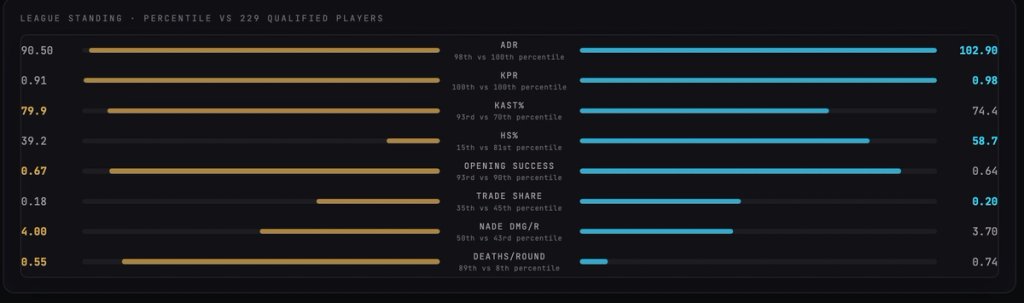
Their kill totals are identical, but their KAST percentages could be very different. KAST can help identify consistent round-to-round contributors, supportive players whose value is not fully reflected by kills, players who maintain good trading structures and disciplined players who avoid unnecessary deaths.
It becomes especially valuable when comparing players with similar roles.
How player roles affect KAST
Different CS2 roles naturally produce different KAST profiles.
An AWPer such as m0NESY may survive more frequently because of long-range positioning and the importance of preserving an expensive weapon. High survival combined with strong kills and damage can produce an excellent KAST percentage.
An aggressive rifler such as NiKo may take more opening engagements. These high-risk duels can lower KAST when the player dies without a kill, assist or successful trade.
A complete star such as ZywOo may combine survival with strong damage and killing output. This is generally more valuable than achieving a similar KAST mainly through passive survival.
That is why the question should not only be, “Who has the higher KAST?”
A better question is:
How did the player earn that KAST, and what role were they performing?
Use Xtrimis Compare to view KAST alongside ADR, kills, deaths, rating and other performance metrics.
Limitations of KAST
KAST is a valuable statistic, but it cannot fully measure a player’s impact.
1. Every qualifying round has equal value
KAST is binary. A player who survives without seeing an opponent receives one successful KAST round. A player who records an ace also receives one successful KAST round.
The contributions are completely different, but KAST treats them equally. It measures how frequently a player contributed, not how valuable each contribution was.
2. Survival can inflate KAST
Surviving a lost round can be strategically correct, particularly when preserving an AWP or expensive rifle. However, repeated saving can also improve KAST without creating enough opportunities to win rounds.
A player may finish with a strong KAST because of low deaths and frequent saves while producing limited damage or opening impact. Survival should therefore be judged alongside economy, role and offensive production.
3. KAST is role-dependent
Entry players regularly accept more risk than passive riflers, rotators or AWPers. An entry may die while creating space for the rest of the team. When the death is not traded, the round hurts the player’s KAST even if the attempt was strategically necessary.
Meanwhile, a player operating in a safer role may record a higher KAST through survival. Directly comparing the two percentages without role context can therefore be misleading. The XOR methodology evaluates players across multiple areas rather than allowing one statistic to determine the entire rating.
4. Traded deaths depend on teammates
A player can position correctly for a trade, but the result still depends on the teammate behind them winning the follow-up duel.
A well-spaced entry may receive no KAST credit when the teammate misses the trade. A questionable death may still receive credit when a teammate reacts quickly. Trading reflects individual positioning, but it also depends on team structure, communication and teammate performance.
5. KAST ignores the value and timing of actions
An opening kill that gives the team an early advantage can transform a round. A late exit kill in an already lost round may provide far less value.
Both count equally towards KAST. The metric does not directly consider when the action happened, the round economy, opening impact, clutch pressure, opponent equipment or whether the action changed the result of the round.
This is why KAST should be combined with damage, openings, multi-kills, clutches and other impact statistics.
KAST vs K/D
KAST and K/D measure different aspects of performance.
K/D compares a player’s kills with their deaths. It is useful for understanding fragging efficiency but does not reward assists or traded deaths.
KAST captures more forms of involvement, but it can reward passive survival and treats actions of very different value equally.
Neither statistic is sufficient by itself. A stronger evaluation combines KAST for consistency, K/D and kills per round for fragging, ADR for damage output, opening statistics for early-round impact, trading data for team structure and role context for fairer comparisons. The Xtrimis player comparison tool allows these statistics to be examined together.
Use the Xtrimis KAST leaderboard to discover the most consistent CS2 players, compare them through Xtrimis Compare, and examine their full player profiles to understand how their KAST percentage was earned. KAST is valuable evidence, but it should never be the entire argument.
Frequently asked questions
1. What does KAST stand for in CS2?
KAST stands for Kill, Assist, Survived or Traded. It measures the percentage of rounds in which a player met at least one of those conditions.
2. How is KAST calculated?
Divide the number of qualifying KAST rounds by the total rounds played and multiply the result by 100.
3. Is 75% KAST good?
Yes. A KAST of approximately 75% is generally very good, particularly when maintained across a meaningful number of maps.
4. Is 80% KAST good?
An 80% KAST is exceptional over a large sample. It shows that the player contributed through a kill, assist, survival or traded death in four out of every five rounds.
Is KAST better than K/D?
Neither is automatically better. K/D measures fragging efficiency, while KAST measures consistency across more forms of involvement. They are most useful when analysed together.